Skip to Content (press ENTER)

Header Skipped.

LIBRE Profile Scoring & Science

Attempting to return to everyday life after a burn injury can be difficult, stressful and emotionally challenging. While traditional rehabilitation strategies for burn survivors focus on physical recovery, the Life Impact Burn Recovery Evaluation (LIBRE) Profile project focuses on the impact burn injuries have on a person’s social life. 

The LIBRE Profile is available both as a regular survey (otherwise known as a “Short Form,”) or as a mobile application that modifies the questions based on initial responses (otherwise known as a “Computer Adaptive Test.”)

The LIBRE Profile may be used by:

  • Burn survivors and their loved ones for self-assessment and tracking.
  • Clinicians for assessing patients and identifying individuals who may benefit from additional resources, or for clinical quality improvement.
  • Community organizers for community needs assessments.
  • Researchers for quantifying social participation in a wide range of studies. Examples include intervention effectiveness studies or longitudinal outcome studies that compare same-domain scores across different time points.

Target Population

Adults 18 years of age or older with burn injury ≥ 5% total body surface area or to critical area(s) (e.g., hands, feet, face, genitals).

Studies are underway to develop a questionnaire to assess the impact of burn injury on child health in preschool and school-aged children. Actively enrolling; learn more here.

Administration Instructions

The LIBRE profile measures different aspects of an individual's ability to engage in everyday social situations across six social participation domains (areas) identified as important to people with burn injury (see below.) Each of the domains can be completed by themselves or in combination.

The LIBRE Profile can be completed one of three ways:

  1. With paper and pencil
  2. Via a mobile app
  3. Researchers can build electronic systems to capture responses using tools such as REDCap

Item responses are then added up to obtain raw scores for each domain, which can then be converted to a standardized score using a score transformation table.

Scoring

How is the Standardized Score (T-Score) interpreted?

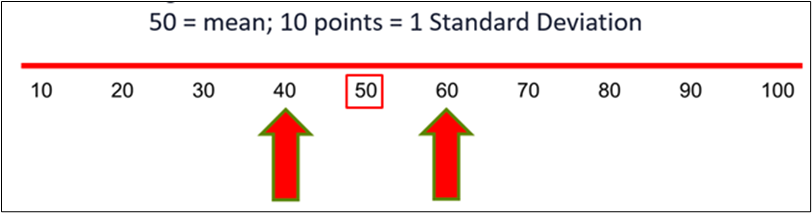
The Standardized Score (T-Score) places the participant’s score on a common metric based on a calibration study of 601 adult burn survivors.  The Standardized Score (T-Score) has a mean of 50 with a standard deviation of 10. Standardized Scores (T-Scores) can be interpreted as follows:

  • LIBRE Profile-SF scale score of 50 – The burn survivor’s level of social participation is similar to the average level of social participation of the adult burn survivors included in the calibration sample.
  • LIBRE Profile-SF scale score of 40 – The burn survivor’s level of social participation is 1 standard deviation below the level of social participation of the adults included in the calibration sample.
  • LIBRE Profile-SF scale score of 60 – The burn survivor’s level of social participation is 1 standard deviation above the level of social participation of the adults included in the calibration sample.

Standard deviation example


Level

Score Range

Description

Relationships with Family and Friends involve spending time together, close relationships, and getting along.

1

<30

I am very uncomfortable in my relationships with family and friends. I get very little or no support.

2

31-44

I am somewhat uncomfortable in my relationships with family and friends. I get some support.

3

45-60

I am somewhat comfortable in my relationships with family and friends. I get quite a bit of support.

4

>61

I am very comfortable in my relationships with family and friends. I get a lot of support.

Social Activities involve outdoor activities, going to community events, and doing things with family and friends.

1

≤28

I am very uncomfortable and almost always avoid participating in social activities.

2

29-45

I am moderately uncomfortable and often avoid participating in social activities.

3

46-58

I am moderately uncomfortable and often avoid participating in social activities.

4

>59

I am comfortable and hardly ever avoid participating in social activities.

Social Interactions involve meeting strangers, going out with friends, and being in public.

1

<22

I am very uncomfortable and almost always avoid social interactions. I am very much troubled by my appearance and how others react to me.

2

23-35

I am moderately uncomfortable and often avoid social interactions. I am quite a bit troubled by my appearance and how others react to me.

3

36-54

I am mildly uncomfortable and sometimes avoid social interactions. I am somewhat troubled by my appearance and how others react to me.

4

>55

I am comfortable and hardly ever avoid social interactions. I am a little bit or not at all troubled by my appearance and how others react to me.


1

<30

I am very uncomfortable in my romantic relationship(s).

2

31-42

I am somewhat uncomfortable in my romantic relationship(s).

3

43-54

I am somewhat comfortable in my romantic relationship(s).

4

>55

I am very comfortable in my romantic relationship(s).

Sexual Relationships involve interest in sex, ability to have an orgasm, emotional closeness, and being able to do sexual activities.

1

≤27

I am very uncomfortable in my sexual relationship(s). My sexual relationship(s) is (are) not satisfying.

2

28-44

I am somewhat uncomfortable in my sexual relationship(s). My sexual relationship(s) is (are) somewhat satisfying.

3

45-61

I am somewhat comfortable in my sexual relationship(s). My sexual relationship(s) is (are) satisfying.

4

>62

I am very comfortable in my sexual relationship(s). My sexual relationship(s) is (are) very satisfying.

Work and Employment involve going to my job, keeping up with my work responsibilities, learning new things, and relationships with people at work.

1

≤30

I am very unsatisfied and uncomfortable at my job. I have many difficulties doing my work.

2

31-40

I am somewhat unsatisfied and uncomfortable at my job. I have some difficulty doing my work.

3

41-50

I am somewhat satisfied and comfortable at my job. I have few difficulties doing my work.

4

>51

I am very satisfied and comfortable at my job. I have hardly any difficulty doing my work.


FAQs

What if the burn survivor lacks the cognitive ability or language skills needed to answer the LIBRE Profile items?

If the burn survivor cannot read or answer the items due to cognitive impairments, intellectual disabilities, impaired language abilities, or other reasons, the LIBRE Profile should not be administered.

What if the burn survivor has visual or motor impairments and cannot complete the assessment independently?

A “recorder” (e.g., clinician, family member) can help to record responses. The recorder should not influence or answer items for the burn survivor.

What if a burn survivor skips an item or several items?

Encourage the burn survivor to answer all questions in order to obtain the most accurate score; however, if the burn survivor is not able to, or does not want to answer a question, he or she may leave it blank.